

1b. Formulate an Information Search Question#
Introduction#
Once you have your topic, it is time to formulate an information search question. This is a process that requires time and thought, and importantly; specifying exactly what you want to study. What information do you need to further shape your project?
The terms research question and information search question are sometimes used interchangeably. In this guide we distinguish between information search questions and research questions. We define them as follows:
A research question is the focus of you master thesis project, something you want to design or research. The answer of a research question commonly cannot be found in literature, but by experimenting and prototyping.
Information search questions help you find out what others have designed or researched about your topic or research question. They are directly related to your (draft) research question, but can be answered by conducting a literature search.
There are specific moments when relating to what others have written is necessary:
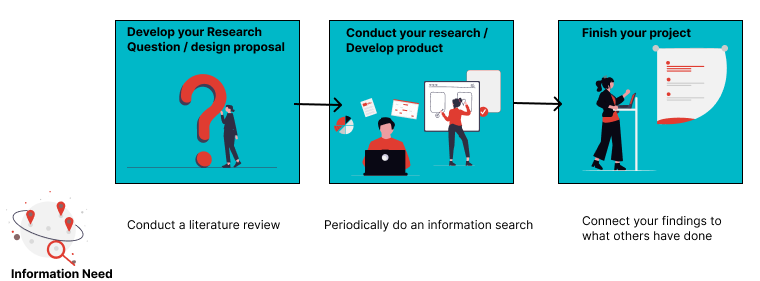
Beginning of your project: You conduct an in-depth review on what others have done (literature review), based on a preliminary research question or topic. These results help you formulate your final research question as well as what research methods you will use to do your research.
Conducting your research: Throughout your project you should be reflecting on your findings and connect them to the literature you have already found. This can also help you if need to update your research or design methods. In addition, while conducting your own research, you should periodically search for sources, based on new concepts you encounter, the results you are finding, and to check if any new research has come out.
End of your project: When you finish your project and write your conclusion and discussion, you synthesise your findings with what others have done. This means looking once more at the sources you have processed throughout your project, and discussing how your findings connect to these sources. For example, how do your findings differ from what others have found before?
Define Components
Define the initial building blocks of your question
Specify Further
Break your question down into broader or more narrow components
Step 1: Defining Components of an Information Question#
When you have done an initial exploration of your sources, take your mind map or summaries and try to formulate an information search question. You should define the what, how, why, who and where you are going to study.
Tilburg University has some good considerations on formulating a relevant question for an information search (Van Lier, n.d.). It should be:
Clear
Specific
Manageable within the time you have
Example Research scenario#
Once you have gathered some information around your topic, you can use a concept map to structure and organise your initial brainstorm. In the concept map you visualise the relations and dependencies of a topic by connecting them with branches, which gives you a clearer overview of your subject. You can then use the concept map to formulate various information search questions by looking at the relations and dependencies of different branches of the concept map.
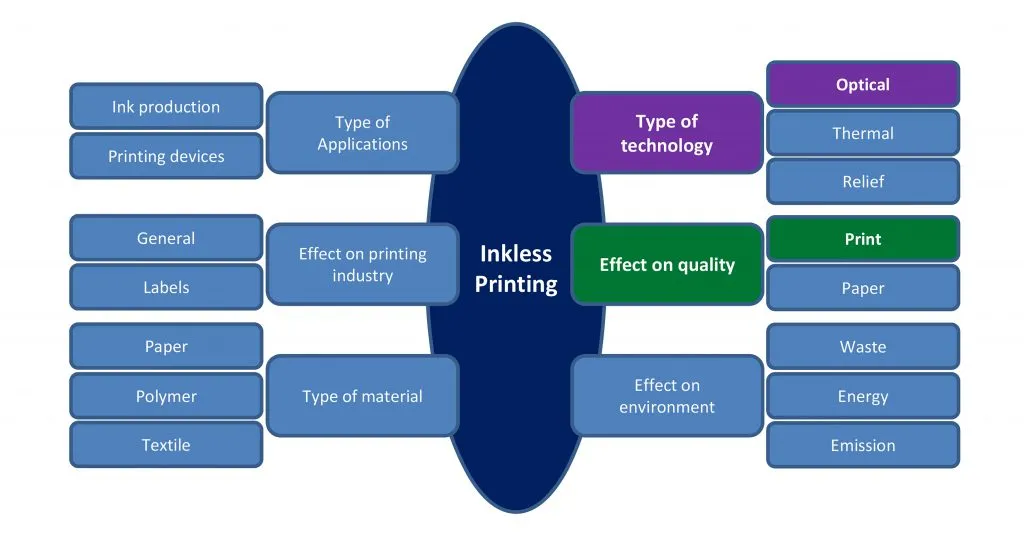
”Concept Map” from TUlib is licensed under CC-BY-SA
From this concept map we have formulated the following information search question:
“How can the print quality of inkless printing be improved by using optical technology?”
Another possible information search question could be:“How does inkless printing by optical technology influence the energy consumption of the printing industry?”
Want to learn more about how to get started with conceptmapping? Have a look at this video about concept mapping
Step 2: Further Specifying Your Question#
Narrow or Broaden Specific Components#
Once you have your initial question, you can look at its different components and make them more or less specific. The example below from Maastricht University shows how you can narrow or broaden components of a specific question.
”From broad to narrow: writing your research question” by Maastricht University Library is licensed under CC-BY-SA 4.0
Need more information? Check out this guide from Maastricht University
Please note: not all components in your information search question need to be as specific as in this example. Think about what information you need exactly. For example, if you are looking for specific methodologies, the components of your question might not need to be highly detailed about the where or the who, but more about what others have done and why.
Make Subquestions#
To further specify your information search question and make it more manageable, it can be helpful to divide it into sub-questions. In order to answer the information search question “How can the print quality of inkless printing be improved by using optical technology?”, you should formulate a number of sub-questions to further specify your search:
Question |
Explanation |
Example |
|---|---|---|
What? |
Definitions of terms |
What is the definition of print quality? |
How? |
Relations between terms |
How can optics technology influence the print quality? |
Why? |
Benefits of Research |
Why would you improve inkless printing technology? |
Who? |
Target Group |
Who would benefit of wider use of inkless printing technology? |
Where? |
Geographical Demarcation |
Where would the improved inkless printing technology be most of use? |
A research topic can consist of multiple terms. The ‘What’ and ‘How’ sub-questions can therefore be posed multiple times. Very often, you won’t be able to answer all five types of sub-questions. The ‘What’ and ‘How” sub-questions must always be posed, but the why, who and where questions depend on how specific your research topic is.
THESIS SUPERVISOR
Once you have formulated an initial information search question, this is a great moment to get feedback from your supervisor. You can also try to explain your information search question to a fellow student, it will likely help to further shape your questions.
References#
Van Lier, M. (n.d.). LibGuides: Tackling Information Problems (TIP): Formulate your research question. Tackling Information Problems (TIP). https://libguides.uvt.nl/tip-tutorial/research-question