

Overview of Information Skills#
When doing your master thesis, there are multiple points where you will need information from others. For example, you need to find out what others have done so you can find out what would be a good research question to start working on. Perhaps you need to find out how others have designed a specific product so you can reuse or build further around this method. Or maybe you have done your research and need to see how your findings relate to what other researchers have found. To be able to do this effectively and responsibly during your master thesis, you will need the following information skills:

Adapted from “Visualisatie leerlijn Information Literacy” by Edo-Jan Meijer is licensed under CC-BY-NC.
Explore: Apply basic steps for orientation on the topic or question of your master thesis
Search: Set up and store a basic search strategy for scientific literature for your master thesis
Evaluate: Use basic ways to assess relevance and reliability of sources, select information for your master thesis and know how to store information effectively
Process: Understand how to read, summarise and synthesise during your master thesis
Share: Apply correct citation and copyright practices when handing in your master thesis. Know about open science principles when publishing your research.
In the guide we present the skills back to back, and provide you with best practices for each of them. Note that these skills are sometimes indeed sequential, but you will also find that throughout your project you will be revisiting them multiple times as during the different phases of a master thesis you will have different information needs. In addition, your need for information will differ depending on which type of project you are doing (for example designing a new product versus doing experimental research).
Below you can find an overview of the different phases of a master thesis, and the information needs you will have for each of them:
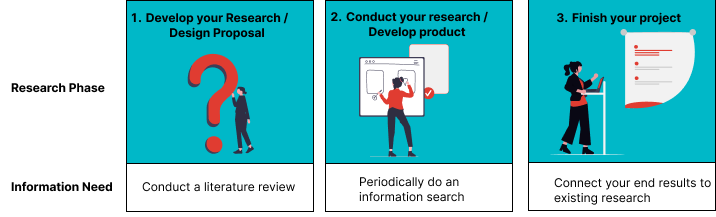
1: Develop your Research / Design Proposal:
When you start your project, you conduct an in-depth review on what others have done (literature review), based on a preliminary research question or design challenge. These results help you formulate your final research or design proposal (for example, what knowledge gap will you address, what methods will you use?).
2: Conduct your Research or Develop your Product:
As you are doing your actual research or design, you will likely encounter interesting findings, or run into issues. At these points, returning to literature can help you reflect on your findings, or help you find new approaches to doing your project. Moreover, especially when you are doing a longer-term project, like a thesis, you should periodically search for sources, based on new concepts you will encounter, the results you are finding, and to check if any new research has come out. While doing your project, you reflect on your findings and connect them to the literature you have already found. This can also help you if need to update your research or design methods.
Tip
Don’t wait until the end to write down all your observations: try to already note down your insights and start processing and engaging with your sources and synthesising as you are doing your project to save you time in the end.
3: Finish your Project:
When you finish your project and write your conclusion and discussion, you synthesise your observations, findings and notes with what others have done. This means looking once more at the sources you have processed throughout your project, and discussing how your findings connect to these sources. In addition, in this phase, citing and using copyright correctly as you reuse the work of others becomes even more important as you are sharing it with others.
On AI and Information Skills#
Throughout the guide we will occasionally discuss the use of AI. GenAI tools can be helpful during the research process if they are used correctly. At the start of your project, you should check whether you are allowed to use these tools, and in what way. For more information on acknowledging your use of AI you can also have a look at this section.
THESIS SUPERVISOR
It is strongly suggested that you discuss your planned AI use with your thesis supervisor and check what is allowed.
GenAI use comes with a lot of considerations, and this means you should critically evaluate the output of a tool, as well as the need to use a tool. We provide here some general considerations you should take into account, as well as five principles on working with AI in general. Where relevant, we provide additional considerations in related chapters.
The texts below are adapted from:
“What is Generative AI.” Walma, L., & Looij, M. AI for Literature Review” is licensed under CC-BY-4.0
AI Literacy for Lecturers by Teaching and Learning Services, TU Delft is licensed under CC-BY-NC-SA-4.0
For your project, you might be working with sensitive data, like company data or personal information. It is often unclear how the input (prompts) from users are processed in GenAI tools. These could also be (and often are) used for training purposes. It is therefore important to never insert personal details or confidential information in GenAI tools. If you are allowed to use AI, and are handling confidential information, consider using a tool that will run AI models locally on your laptop, like Ollama.
AI tools can produce incorrect or misleading information. The output of AI systems can, for example, include citations that look realistic, but don’t really exist. Ask any AI to find you some academic sources on a topic and you are presented with a plausible list of seemingly high quality scientific sources. However, these references don’t always exist. For example; In July 2026, research from the Dutch magazine De Groene Amsterdammer revealed that, since the release of ChatGPT, the proportion of scientific articles containing non-existing references has increased sevenfold (read about the research in English here). You should always verify the output of AI with reliable sources.
GenAI tools are trained with real-life data. The output can therefore reflect and amplify biases from human thinking. For example, research has shown that outputs of GenAI tools often include biases against women and people of colour. Other biases, for example confirmation bias (the tendency to search for and favour information that confirms your beliefs), can also affect the data that is used for training the GenAI tool, and therefore also affect the output. So, also from the perspective of potential biases, it is important to always critically check the GenAI output.
GenAI tools are trained with data that is publicly available. However, the authors of the texts that are used for training purposes did not give permission for this. Although GenAI tools do not typically copy exact passages, they do extract patterns, styles and ideas. This leads to a grey area of potential copyright infringement. In addition, it is often unclear how GenAI tools use the input (prompts) from users. These could also be (and often are) used for training purposes.
It is therefore important to be careful with your GenAI input. Some guidelines include:
never insert personal details
never insert confidential information
only insert work from others if you have their explicit consent (also to avoid copyright infringement).
Be aware that your input may be used for training purposes. If you don’t want your research project to be used for these purposes (for example, because you are dealing with sensitive information or because you don’t want others to know what you are working on), it is advised not to use AI, or use a tool that will run AI models locally on your laptop, like Ollama.
Relying too much on AI limits the development of your critical thinking skills, as well as your mastering of your research subject.
While using AI during your thesis journey, for example to find information and synthesise your findings might seem like it saves you time, in the end overusing AI can limit the development of a set of skills you will need in your future career. In a recent interview with Delta several TU Delft students said that while they found AI use was helpful, they worried that its use also limited the development of their critical thinking.
One practical way to think about AI and learning is to distinguish between useful friction and unnecessary friction
Useful friction is effort that contributes to learning. Just as muscles develop through physical effort, you develop knowledge, skills and judgement by working through meaningful challenges. If too much of that effort is taken over by AI, your thesis may still look well, but miss the learning process that gives the result its value.
Useful friction during your information journey includes, among others, creating a search strategy, reading, and synthesizing your findings. As you are doing this you practice the thinking and decision-making skills for your future career. In addition, by working through this useful friction you learn more about your topic. In the end of your project you need to master your subject and explain how you arrived at your research conclusions or final product: you are the one who is standing on the spot and has to answer questions from your committee.
Unnecessary friction is effort that does not meaningfully contribute to the intended learning. This may include struggling with formatting, overcoming minor language barriers, converting notes into a clearer structure, or helping to get started with a topic. In these cases, AI may help reduce barriers without necessarily replacing the core learning, but you should consult with your supervisor what is helpful and allowed.
The environmental impact of GenAI is significant: it uses great amounts of water and energy for running the models (i.e., responding to prompts) and training them. In addition, building data centers and servers that run these models requires great amounts of (raw) materials. Specifically, a United Nations Environment Programme report shows that (1) making a 2 kg computer requires 800 kg of raw materials, (2) the microchips that power AI need rare earth elements, (3) data centers produce electronic waste, which often contains hazardous substances such as mercury and lead, (4) global AI-related infrastructure consumes six times more water than Denmark, a country of 6 million and (5) one request made through ChatGPT consumes 10 times the electricity of a Google search. For more information about the environmental impact, consult this Greenpeace report, which also highlights the dependency on Big Tech.
Because of the significance of the environmental impact, it is advisable to take this into account when considering using a GenAI tool. For simple tasks, it might be better to do it without GenAI to limit the environmental impact.
Five principles for working with AI
For effective and responsible GenAI use, keep the following five principles in mind:
Prompt: Effective GenAI use starts with an effective prompt. Make your prompt specific, using (relevant elements from) the format: clear task-description + persona + context + format + tone + exemplars
Proof: Always check the output for inaccuracies and biases. Critically evaluate the quality of the output, using your own critical thinking skills.
Privacy (and other considerations): There are many unknowns about how GenAI tools use your input. Never feed personal details or confidential information to GenAI tools. Also consider the environmental impact of GenAI before using it.
Presentation: The output from GenAI tools may include grammatically correct sentences, but it is often generic and flavourless. Don’t forget about your own voice when you are writing a text.
Property: In the end, always remember that you are responsible for your work, also when you use GenAI.
Adapted from “Summary Part 1: Effective and Responsible GenAI Use”. Walma, L., & Looij, M. AI for Literature Review is licensed under CC-BY-4.0