

Relevance of file naming & folder organisation#
File naming and folder organisation matter because these practices lead to:

"Research insights" by TU Delft Library - Education Support is licensed under CC BY 4.0 |
INSIGHTS INTO YOUR RESEARCH PROCESSIdeally, files are named and organised in a way that helps document the process or sequence that you followed to gather the data. File names should provide hints about why/how each piece is relevant. Effective file naming and documentation of file naming schema makes it easier to retrace your steps in a project when it’s time to analyse your results. |

"File finding" by TU Delft Library - Education Support is licensed under CC BY 4.0 |
INCREASED EFFICIENCYIt’s no fun hunting frantically for that one specific piece of information that you collected last month: spending a little time upfront to organise your files increases their findability. This can save you a lot of time (and lower your stress level) in the long run. |

"Data management helps your future self" by TU Delft Library - Education Support is licensed under CC BY 4.0 |
BETTER ORGANISATIONFile naming and folder organisation best practices will help you to be more organised in your BSc thesis research and in general: in your studies you will likely be working with larger quantities of data over longer periods of time. You may have it all in your head now, but forget major details two months from now. It’s helpful to have systemic, well-documented methods for naming and organising your files now so that your future self can easily understand and locate what you did. |

"Collaborative efforts" by TU Delft Library - Education Support is licensed under CC BY 4.0 |
EFFECTIVE COLLABORATIONYour file naming choices and folder structure should help a collaborator or supervisor to follow the steps of your research and understand the pieces of your work. When working on collaborative projects, establishing a common/standard folder structure and naming conventions can facilitate collaborative work because everybody knows where to easily find the data they need for the different pieces of the project, making the collaboration more effective. There is no single "right" way to name files and organise folders, but your system of organising data and files needs to work for everyone involved in the work. |
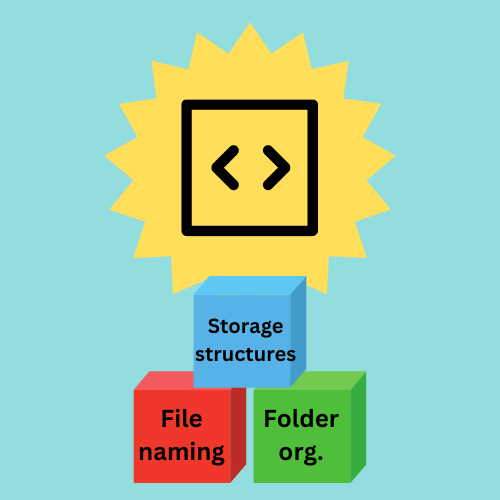
"Building blocks of computer programming" by TU Delft Library - Education Support is licensed under CC BY 4.0 |
REINFORCING COMPUTER SCIENCE PRINCIPLESThe concepts in this module reinforce skills and habits of thinking that you will need for computer programming. For example, understanding folder structures can help you become a more intuitive user of a command line interface. It can also help you to more intentionally organise and store code and documentation for collaborative projects. Moreover, this mini-module will prepare you to practice better version control by reinforcing habits of systemic naming. |
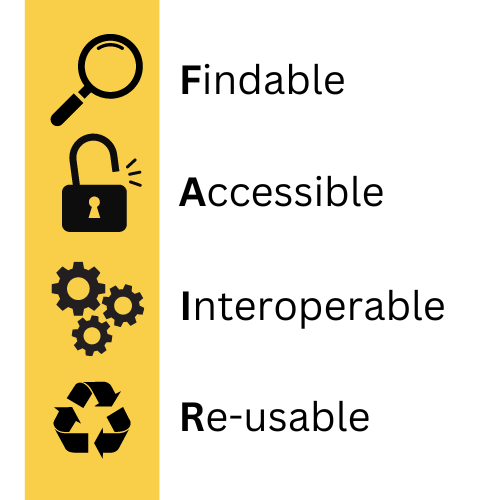
"FAIR" by TU Delft Library - Education Support is licensed under CC BY 4.0 |
ESSENTIAL TOOLS FOR FAIR DATA SHARINGGood folder organization and file naming makes research data and files more FAIR (this stands for Findable, Accessible, Interoperable, and Re-usable). Researchers who work according to FAIR principles can have a greater scientific impact, and their work gets cited more (Alves, 2024). As a BSc student, you’ll be able to work smarter if you make your files and data more findable and accessible. In the modern digital landscape, it’s also beneficial to develop good digital hygiene around data storage and sharing. |
Relevance for you?#
This section discussed many reasons to expand your knowledge of file naming and folder organisation. The next parts of this module aim to provide tools and guidelines which will be immediately applicable to your bachelor’s coursework.
Before proceeding, please indicate which of reasons discussed is most important for you and why: